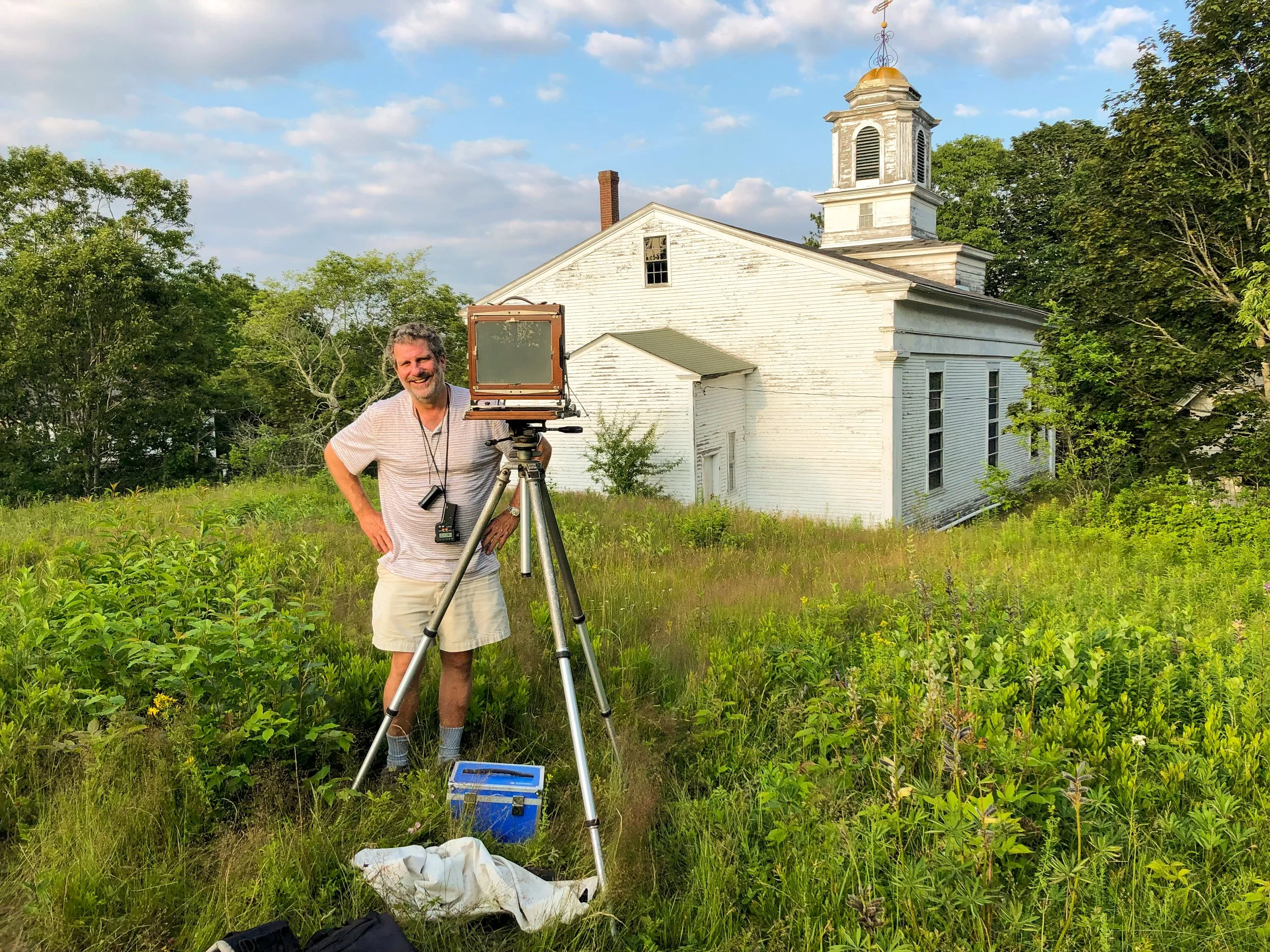
When Jack Ledbetter aims a camera at the landscape, at an element of New England architecture, at a nude framed by a Maine coast ledge, he brings a lifetime of photography to the moment. Committed to the art and craft of the lens since he was a youngster growing up in Georgia, today Ledbetter is a consummate camera artist, a master of light and composition.
Ledbetter’s large color prints, coveted by collectors, display clarity of vision that invites the eye to linger and explore. Encompassing both expanse and detail, these photographs of Maine reward multiple viewings. They lead us into a special landscape, be it a view of Mount Desert Island from Baker Island, a complex patch of tidal ledge, or a crashing wave at Prout’s Neck. The presentation of the image is impeccable, the sense of light and weather extraordinary.
Maine islands are among Ledbetter’s favorite motifs; he spends as much time as possible exploring the vast archipelago in search of subjects. He is a master of the panorama, hiking to the top of Mount Desert Island’s mountains or boating to an outer island in order to gain access to remarkable vistas. He knows that there is no forcing a sunrise or sunset, a bank of fog or tidal swells; patience is an absolutely necessary virtue. Stunning photographs bear out this willingness to wait for the perfect shot.
Every year Ledbetter produces a dozen or so new images in addition to pieces commissioned by clients (he often travels to fulfill these special assignments). He also works in series, as witness the impressive limited edition portfolio of photographs of the Rockefeller bridges in Acadia National Park produced in 2005-2006.
Rare among his peers, Ledbetter is as accomplished in black and white formats as he is in color. He highlights architectural elements—the shinglework on a church in Southwest Harbor, the steeple of a parish house in Castine—in a way that makes the viewer stop and admire them. Like Edward Hopper, he is drawn to the design of a church, a lighthouse, a barn.
Ledbetter’s studies of Maine architecture are significant not only for their aesthetic qualities—clean lines, compositional finesse—but also for the record they provide of a vernacular that is fast fading. A preservationist, it is with regret that he notes the passing of a particular structure, lost to the elements and/or disregard.
Ledbetter is as practiced in his presentation of the figure as he is in capturing the landscape. In a series of nudes set among rocky outcroppings on Mount Desert Island, he highlights the beauty of the human body, contrasting the textures of flesh with the geological primacy of coastal rock. Where his landscapes and architectural studies are sharply focused, the nudes are more tonal.
Asked about his favorite photographers, Ledbetter invokes two American masters, Paul Strand and Walker Evans. He shares with them an appreciation for shape and light, for the beauty of a Maine steeple or an ordinary pump handle. Some of his knowledge of the history of photography derives from studies at the International Center for Photography in New York City in the early 1980s, but much of it comes from a personal desire to know and learn from his predecessors.
While Ledbetter has shown his photographs from time to time in Maine, in his home state of Georgia and elsewhere, he is primarily an independent artist who is happiest when ensconced in the darkroom developing a print. Arriving in Northeast Harbor in the mid-1980s, he exhibited work at Wingspread Gallery. A few years later he established his current studio and showcase.
Over the past decade and a half, Ledbetter has placed his photographs in prestigious private collections and museums across the country. Recently, the Portland Museum of Art and the Farnsworth Art Museum acquired his work. He has many clients who return every year to purchase an image of the Maine coast or one of his black and white prints. They recognize the work of a seasoned photographer who delivers the world to their welcoming gaze.
-
At Aiken Preparatory School from 6th to 8th grades, Jack learns how to work in a darkroom through one-on-one instruction from Tish Meyers. He works on the school yearbook. Tish invites Jack to accompany her to visit family in Christmas Cove Maine in 1974, Jack’s first experience of the state. They sailed, went hiking, and spent time outdoors in the summer, a unique experience for a young man from Georgia.
-
During high school at Albany Junior College, Jack works in commercial photography for a local ad agency, including several political campaigns.
-
Jack moves to New York City to formally study photography and immerse himself in the art world. He attends the International Center of Photography (recently founded by Cornell Capa), Parsons School of Design, and The New School. He travels to Paris in 1981 for a summer program and serves as a teaching assistant for a summer program in Lake Placid, NY. During these formative years, he attends many lectures and exhibitions which will influence his work. His mentors included Via Wynroth, Nathan Ford, Joel Greenberg, Joel Sternfield, Paul Kwilecki, Benedict Fernandez, and Kate Carter.
-
Jack visits Acadia National Park for the first time and takes his first photos of the Maine landscape with black and white film on a 4x5 camera. He returns to Georgia but can’t forget his summer in Maine.
-
Jack rents a bungalow from David Thurlow, a lobsterman in Bass Harbor, and spends the summer photographing Acadia National Park and other parts of Maine with an 8x10 field camera.
-
Jack returns to Maine and decides to stay indefinitely. He meets Aurelia “Thistle” Brown, who represents him and sells his photographs in Wingspread Gallery. He is published for the first time in Down East Magazine.
-
Rizzoli publishes Jack’s first book of photographs, Maine: The Coast and Islands. Roger Howell, Jr., tenth president of Bowdoin College, writes the foreword.
-
Jack rents an independent studio space in Northeast Harbor. The 850 square foot working gallery contains a darkroom, a workshop for framing, and space for showing and selling his own work. He remains here until the present day.
-
Jack scales up his productivity, photographing the Maine landscape and Acadia National Park in black and white and color with a large format camera. He begins experimenting with figurative photographs. The addition of a small runabout boat gives him the opportunity to expand his subjects to include the beautiful coastal islands like Baker’s Island, Placentia Island, and The Ducks. A “summer” family purchases 50 of his landscapes for their Seal Harbor Estate. He continues to spend time in Albany, Georgia regularly, creating large format black and white portraits of locals.
-
John Wilmerding, art history professor at Princeton and retired deputy director of the National Gallery, purchases a large selection of Jack’s landscape photographs, as he has just donated much of his own art collection to a major museum.
-
Jack continues to work out of his Northeast Harbor studio. He adds 11x14 and 16x20 prints to his already extensive collection of large format photographs of the Maine landscape, nude figures, and architectural studies. Another summer resident purchases over 50 of his photographs to decorate their new estate. Jack experiments with vintage soft focus lenses, creating incredible 16x20 contact prints with a glowy, ethereal character.
-
While continuing his work in Maine, Jack also begins to photograph his native Southwest Georgia, capturing swampland, creeks, farmland, long-abandoned industrial buildings, and dilapidated, once-graceful mansions.
-
Jack photographs the Abby Aldrich Rockefeller Garden for David Rockefeller, Sr. as a record of how the garden existed in his lifetime, before it was handed over to the Mount Desert Land and Garden Preserve.
-
Jack begins a series portraying people within the Maine landscape composed at night and lit only by the full moon. It is his favorite work to date and represents the culmination and combination of his various interests in the human figure, bucolic garden settings, and the rugged coast.
-
Bessemer Trust purchases a number of Jack’s photographs to decorate their New York City offices in the former Time Life building on 6th Avenue.
-
Carl Little publishes “Seize the Light: Jack Ledbetter’s Photographic Vision” in Maine Boats, Homes, & Harbors Magazine, a retrospective of Jack’s time in Maine reflected through photographs of off-the-beaten-path scenes of the Maine coast from the 1980s to present.